Showing posts with label self-care. Show all posts

Tuesday, April 12, 2022

Self Love #25


Have you heard of the 5 Love Languages? If you haven't, where have you been??

The author of the Love Languages is Dr. Gary Chapman. They were originally designed for relationships. However, Dr. Chapman has since written the 5 Love Languages for Singles, Men, Couples, Military, and Children. 

You can find more information here: https://www.5lovelanguages.com/learn.

This blog is strictly about the 5 love languages and self love/care. 

The Love Languages are as follows:
1. Words of Affirmation
2. Acts of Service
3. Receiving Gifts
4. Quality Time
5. Physical Touch 

If you have never taken the quiz, here is the link:
https://www.5lovelanguages.com/quizzes/love-language

Take the quiz and return to this blog.

When it comes to deep love and nourishment, too often we look to our partners and relationships. However, loving ourselves and our own self-care should take priority.


Here are some ways you can show yourself love and self-care. 

1. Words of Affirmation: Think Self-Love

If this is your love language, then your thoughts precede your emotions and behaviors.

Here are some methods for self love/self care for this love language:

  • Write down affirmations to yourself and tape them throughout your car, your home, and at work. 
  • Journal your strengths or gratitude, and accomplishments, what you love about yourself.
  • Download the app "Mantra" and recite your mantra everyday. Or write down your own Mantra daily and read it to yourself throughout the day. 
  • Write a love letter to yourself!
  • Purchase Affirmation cards and pull 1 or 2 daily.
  • Download the app "Insight Timer" and listen to a Self-Love Meditation. The app also has self-love courses you can take as well. 
  • Become your own cheerleader and tell your inner critic to take a HIKE!

2. Acts of Service: Do Self-Love

If this is your love language, you need actions you do for yourself. Such as self love activities like checking things off of your to-do list or cleaning your living space where your future self will thank you. How can you be of service to yourself?


Here are some Acts of Service you can do to show yourself love and care:

  • Prepare healthy meals for yourself. Grocery shop with intention and health in mind. 
  • Create an clean, organized, home environment for yourself. 
  • Schedule regular physical, dental and mental health check-ups.
  • Groom yourself with love and care - facials, mani/pedis, haircut/color, etc 
  • Make a to-do list and mark things as off as you accomplish them.
  • Set a goal and make a plan to accomplish it.
  • Buy a planner and organize your life. 
  • Purge the stuff that doesn't bring you joy.

3. Receiving Gifts: Absorb Self-Love

If this is your love language, it means you will feel self love fully through the investments you put into gifts for yourself, whether it’s something small or a bigger high-ticket item.


Here are some ideas for self-love and self-care through receiving gifts:

  • Buy only what you love. Don’t allow things in your home and closet that don’t bring you positive vibrations.
  • Gift yourself with an experience on your bucket list. Budget it out and plan it.
  • Invest in your education and advancement. Take a course or a class. 
  • Treat yourself travel, whatever your budget allows. 
  • Buy some new bed sheets or pajamas 
  • Treat yourself to a massage
  • Take yourself to the movie you've been dying to see or to a play you've wanted to see. 
  • Buy yourself some flowers!

4. Quality Time: Be Present with Self-Love

If you find that your self care love language is quality time, that means you appreciate the time you invest in yourself from relaxing alone time to time spent on a fun hobby or improving a skill.
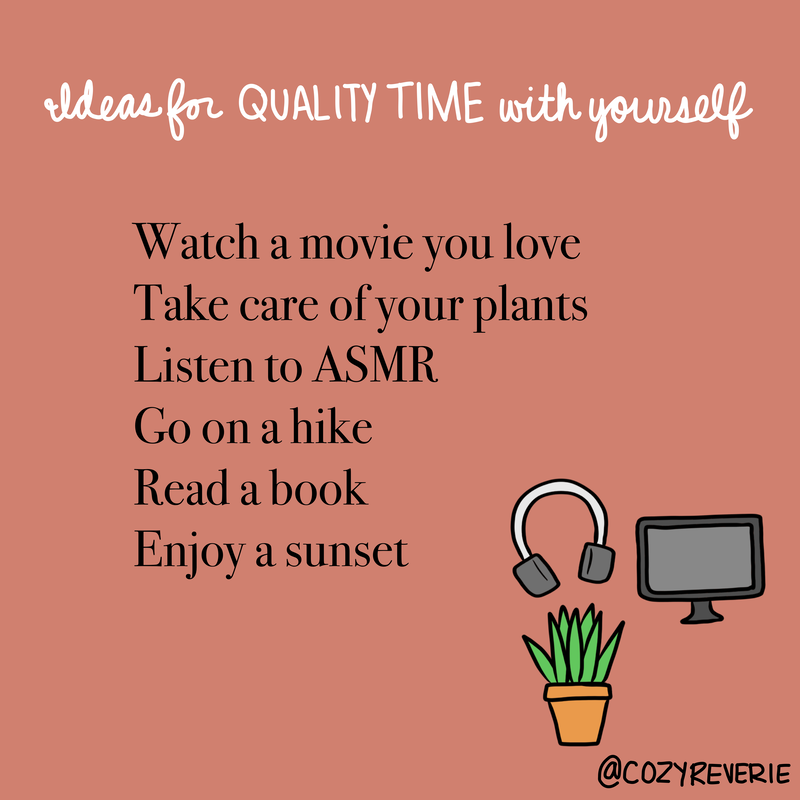


Here are some ways to show yourself some love with quality time:

  • Set aside time for daily mindfulness practices such as meditation or deep breathing exercises.
  • Make time for leisure and hobbies. Time for play and enjoyment is an important aspect of life.
  • Prioritize sleep and exercise 
  • Do not over-schedule, over-book or over-commit.
  • Take yourself on a date - dinner and a movie? Yes please. 
  • A night in - hot bubble bath and soothing music.
  • Do some Yoga stretches at home. 
  • Go for a nature hike. 
  • Visit an art museum alone. 
  • Try aromatherapy

5. Physical Touch: Feel Self-Love

Physical touch in the context of self care love languages means that you appreciate self love activities that are physically involved from a relaxing massage to the feeling of comfortable pajamas on your skin.


Here are some ideas for self love and physical touch:

  • Stretch your muscles and give yourself a massage with a foam roller. 
  • Release toxins by taking a hot bath with Epsom salts or essential oils. Release the stress and soak in the love. 
  • Moisturize your skin with lotions or oils. As you touch your skin, thank each body part for all it does for you.
  • Give yourself a spa treatment: manicure, pedicure, facial, deep conditioning treatment, etc. 
  • Dance 

  • Take yourself on a coffee date with a great book.

  • Get a message or give yourself a massage
  • Take a day to just simply rest and do nothing.

Fostering a loving relationship with yourself is incredibly healing and helps you connect with others more authentically. 


And just for giggles and laughs....


Leave me a comment with your love language. I'd love to know!

https://linktr.ee/deelitefulphotography

Don't forget to subscribe!


Friday, March 25, 2022

Dealing with Imposter Syndrome

***First - My apologies for not posting sooner. I have had a long week of auto-immune joint pain, brain fog, and headaches.***

 Today's topic is Imposter Syndrome

As a photographer, I experience Imposter Syndrome from time to time. When it happens, its usually because I begin to compare myself to other photographers. "Comparison is the thief of joy." The inner critic points out everything I am "doing wrong". This is the reason I do not follow other photographers on social media. (I do follow those that I consider educator/photographers)

What is Imposter Syndrome? 

Imposter syndrome is loosely defined as doubting your abilities and feeling like a fraud. It disproportionately affects high-achieving people, who find it difficult to accept their accomplishments. Many question whether they’re deserving of recognition and accomplishments.

It’s that nagging feeling that you don’t belong, and it affects women and minority groups disproportionately. 


Here’s how to combat it.

It shows up like this:

  • You feel like a fraud. 
  • You devalue your worth. 
  • You undermine your own experience or expertise. 


Here are a few suggestions to combat Imposter Syndrome:

  • Make a list of things you do well. Make a list of at least 10 things that show you are just as qualified as anyone else for the what you do, things you do well. 
  • Say your name aloud with Affirmations. “My name is Dyanne and I’m awesome!” 
  • Own your accomplishments. Women tend to rationalize away their successes by assigning them to things like “luck,” “hard work” or “help from others” rather than the innate ability or intelligence than men often cite. Own the role you played in your success by forbidding yourself from falling back on excuses. Say these words out loud: “I’m proud of what I’ve accomplished.”
  • Visualize success. Visualize precisely how you’ll navigate the situation — successfully — before it happens. This is sometimes referred to as Manifesting.
  • Talk to a colleague or friend. 
  • Unsubscribe from doubt: 
    • There are two kinds of doubt: 
    • Self-doubt, which causes you to freeze up
    • Idea doubt, which can motivate people to refine, test or experiment with a good idea. 
    • Turn self-doubt into idea doubt - Tell yourself: "It’s not that I’m bad, it’s that the first few attempts of any idea are always not good — and I’m just not there yet."

  • Decide to be confident. Literally make the choice to be confident. Raise your hand. Volunteer your expertise. 
  • Remind yourself you’re good at what you do. 


REMEMBER!

Failure doesn’t make you a fraud. Even the best athletes screw up, the best lawyers lose cases, the best actors star in busts. Failing, losing and being wrong on occasion are all part of the job. Don’t let it define you. Learn from your mistakes and move forward.


Tuesday, March 8, 2022

Self Love Masterclass #17

 Self-love and self-esteem are often damaged and deteriorated when we compromise our personal values – our core values.

When I compromise my values and principles, it's like a punch in the gut – from the inside. Self-loathing increases when we stop living by what we believe and stand for.

When we live by our values and principles, it increases self worth and ultimately, is a sign of self-love. It sends a message to myself and others that says, “I stand for what I believe.” This increases confidence and increases respect from others. When we compromise our values we slowly stop respecting ourselves.

If I value honesty, but call in sick to work when I'm not sick – I decrease my self-respect. My inner critic starts reminding me that I am a liar.

If I value trust, but I can't be trusted, then I compromise my values and my self-worth starts to crumble.

If I value respect, but I abuse my body and treat myself and others disrespectfully, my self-confidence will decrease bit by bit.

AND when I compromise my values – I will attract the same type of people as friends and mates.

Here are some steps to get back to living by your values and principles.

Step 1: Make a list of your values and principles – what do you value?

If you have a hard time figuring that out, think of things in your life that make you happy. What principles do you stand for? Do you value family? Do you value honesty? Do you value friendships? Support? Encouragement?

What are the commonalities?

For me, the important things are my family (love), my health, God (spirituality), empowering others (meaningful work), feeling free, alone time, trust, drive, growth, happiness, connection, positivity, authenticity, and adventure.

If you’re having trouble, then do a Google search for a core values list. 

Step 2: Pay Attention to Things that Resurface

Are there things in your life that tend to have similar outcomes?

You may continue picking a particular type of partner.

You may get upset if similar situations arise.

Or you keep quitting and starting a different job.

What you are looking for are instances in your life that you see come up over and over.

With those issues in mind, write down why each situation makes you feel a particular way.

  • If you are happy, then what is it about the situation that makes you happy?

  • If you are angry, then what is it about the situation that makes you angry?

Focus on keywords.

You will see a pattern and realize that many of your values align with your decision-making process.

I used this process in my journal to understand why I continued to delete friends from my life. I realize that my core values in friendships are trust, loyalty, honesty, not judging or competing with me. Some of my friends did not uphold my personal core values, which often hit a trigger for me and caused our friendship to end. At least now, moving forward, I can be honest about what I need in a friendship and what kind of relationship I need.

Step 3: Rank Your Core Values

Now that you have a list of core values that are important to you, rank them. First separate them into categories and then make one overall ranking list. You may have your top 5-8 that speak to you in relationships, career, etc. Rank those in order of predominance.

What this may look like for career/business:

  • Meaningful work

  • Flexibility

  • Growth

  • Environment

  • Inventive

  • Creativity

Step 4: Define your Core Value List

How defining my core values in life help me make confident decisions and change my life.

  • Personal development

  • Mental health

  • Motivation

  • Productivity

  • Habits

  • Self-help

  • Self-improvement

  • Get motivated

  • Procrastination

  • Stop being lazy

  • Change your mood

  • Positivity

  • Willpower

  • Self-care

  • Life tips

  • Advice


Now this is the fun part.

For each word you chose, define what it means to you. There is no way each word can mean the same thing to everyone. Use this step to help with self-discovery and allow the things you write down to manifest into reality.

This section might look like this:

Meaningful work:

  • doing something that empowers or impact others positivity
  • doing something that makes me feel fulfilled inside
  • doing something that allows me to make an impact in the world

Final thoughts: Personal Values

Living by our personal values and principles are a powerful way to help build confidence in our decisions, understand ourselves, and simplify life.

I encourage you to use your values list to help you create the future you envision, especially when you don’t know where to start.

If you find that you have been compromising your values and principles, it's time to make a change. This can be overwhelming. Pick one value/principle and start the change with 1. Work on one value for 30 days. When you feel you are being and living true to that one value/principle, choose another.

The process may be slow, but it's about progress not perfection. This is a lifelong process. Our values can change as we age, mature, and progress through life.

If you need any help with this, please email me @ deelitefulboudoirphotography@gmail.com 

I will help you!

Leave me a comment and let me know if this is helpful.


Thank you!
Dyanne


Tuesday, March 1, 2022

Self-Love Masterclass #15

Today is one of those days for me. Struggling with my inner critic. That voice that tells me I'm a loser. The voice that says "look at their photos. You aren't that good." The voice that says "It's time to give up and throw in the towel. You're never going to be successful."  Blah. Blah. Blah. 

I know that voice very well. 

It's that nasty Inner Critic. That voice that cries out for failure.
  

*****************************************************************************************

How do we deal with that inner critic?

The private conversations we have with ourselves can be either a powerful step or a major obstacle to reaching your goals.  If your inner voice tells you things like, “I’m going to embarrass myself,” or “No one is going to talk to me,” as you walk you into a party, you probably won't appear relaxed and approachable. Or, if you’re thinking, “I’m never going to get this job,” in the middle of an interview, you'll struggle to present yourself in a confident manner. Often, those negative predictions can quickly turn into a self-fulfilling prophecy.

Our thoughts greatly influence how we feel and behave which can cause negative self-talk to become downright self-destructive. Telling ourselves that we’ll never be successful or that we aren’t as good as other people, will reduce our feelings of self-worth and deter us from facing our fears.

If you tend to be overly critical of yourself, you're not alone. Most of us experience self-doubt and harsh self-criticisms at some point in our lives. Fortunately, we don’t have to be a victim of our own verbal abuse. Instead, we can take steps towards managing our negative thoughts and develop a more productive self-talk. Here are some ways to tame your inner critic:

  1. Develop an awareness of your thoughts. We get so used to hearing our self-talk that it’s easy to become unaware of the messages that we’re telling ourselves. Pay attention to what you’re thinking about and recognize that just because you think something, doesn’t mean it’s true. Our thoughts are often exaggerated, biased, and disproportionate.

  2. Stop overthinking (I know – easier said than done). When you make a mistake or you’ve had a bad day, you may be tempted to re-play the events over and over in your head. But, repeatedly reminding yourself of that embarrassing thing you did, or that questionable thing you said, will only make you feel worse and it won’t solve the problem. When you find yourself overthinking – and not actively problem-solving – don’t waste time telling yourself, “Don’t think about that.” The more you try to avoid thinking about something, the more you’re likely to focus on it. Instead, distract yourself with an activity – like going for a walk, organizing your desk, or talking about a completely different subject – and stop the critical thoughts before they spiral out of control.

  3. Ask yourself what advice you’d give to a friend. If a friend expressed feelings of self-doubt, hopefully you wouldn’t say, “You can’t ever do anything right,” or “You’re so stupid. No one likes you.” Yet, we’re often quick to say those things to ourselves. Instead, you’d be more likely to offer a friend compassionate words of encouragement like, “You made a mistake but it’s not the end of the world,” or “It’s unlikely that today’s performance will actually get you fired.” Treat yourself equally as kind as you’d treat a friend and apply those words of encouragement to your life.

  4. Examine the evidence. Learn to recognize when your critical thoughts are exaggeratedly negative. If you think, “I’m never going to be able to quit my job and run my own business,” examine the evidence that supports and refutes this prediction. Sometimes it’s helpful to write it down. Draw a line down the middle of a piece of paper. On one side, list all the evidence that supports your thought. On the other side, write down all the evidence to the contrary. Looking at evidence on both sides of the argument can help you look at the situation more rationally and less emotionally.

  5. Replace overly critical thoughts with more accurate statements. Convert an overly negative thought to a more rational and realistic statement. When you find yourself thinking, “I never do anything right,” replace it with a balanced statement like, “Sometimes I do things really well and sometimes I don’t.” Each time you find yourself thinking an exaggeratedly negative thought, respond with the more accurate statement.

  6. Consider how bad it would be if your thoughts were true. Sometimes it’s tempting to picture a mistake turning into a complete catastrophe. But often, the worst case scenario really isn’t as bad as we might imagine. For example, if you predict that you’re going to embarrass yourself when you give a presentation, ask yourself how bad would that actually be? If you did embarrass yourself, would you be able to recover or do think it would it end your career? Reminding yourself that you can handle tough times or problems increases your confidence and decreases the constant barrage of worrisome thoughts.

  7. Balance acceptance with self-improvement. There’s a difference between always telling yourself that you’re not good enough and reminding yourself that you can work to become better. Accept your flaws for what they are today but resign to work on the issues you want to address. Although it sounds illogical, you can do both at the same time. You can accept that you experience anxiety in social situations, while also making a decision to become more comfortable with public speaking. Accepting your weaknesses for what they are today doesn’t mean you have to stay that way. Acknowledge that you have flaws but stay determined to remain a work in progress as you strive to become better.

  8. The Power of Your Inner Dialogue Your inner dialogue will either fuel your success or prevent you from reaching your full potential. While your inner critic can help you recognize areas where you want to improve, overly harsh negative self-talk will cause your goals and decisions to suffer and reduce the chances that you’ll reach your goals. Practice taming your inner critic and silencing the negativity so you can coach yourself in a productive and helpful manner.

Our inner critics – whatever we may call them – have a powerful influence over our inner lives. They determine not just our overall psychological well-being, but also how successful we are.

The original function of our critical inner voice was to protect us from danger, but later in life negative self-talk can become a major unhealthy habit with wide-ranging negative consequences. But by noticing and labeling these critical inner voices, and practicing the skills outlined above, we can significantly lessen their effect.

If our inner critic were a person, we would avoid them like the plague. They would no doubt fall into the category of an abuser: someone who consistently tears down our sense of self-worth; someone who mocks, berates, and demeans us; who constantly says the most horrific things about us and makes us feel ashamed, guilty, small, and miserable.

Would we tolerate this kind of talk if it were directed at a child, friend, or someone we love? Why, then, should we accept it as our own normalcy? 

Leave me a comment if you relate. Or if you have managed to overcome your own inner critic. 


Thursday, February 24, 2022

Self Love Masterclass #14

 We are more than our bodies.

Have you looked at photographs of yourself and thought, “OMG. I look so fat. I need to lose weight!”

YOU ARE MORE THAN A BAD PHOTO OF YOURSELF.

And we are more than our physical appearance.

We have developed this terrible tendency of longing after the bodies of other people. We follow excessive fitness and celebrity accounts on Instagram, admire models in magazines and become envious of every Victoria’s Secret model after their annual fashion show. We fixate on our “flaws”, strive to transform our bodies to look exactly like the person we wish we were and hate ourselves when we fall short.

Sad, isn’t it? We’ve become used to loving the bodies of others and have grown to hate our own. I’d be lying if I said I was not guilty of such a thing. For years, I destroyed myself mentally by hating the person I was physically. I’d wake up in the morning, look in the mirror and grab onto my stomach in disgust.

Why can’t I be skinnier? Why can't I look like ‘so and so’?”

The questions were endless and depressing. All of a sudden, I realized that throwing a pity party every day was becoming quite sad, depressing, and unhealthy. I was longing after this “healthy” (translation “perfect”) body, but my mental health took a backseat, as well as my self-esteem. Hating my body wasn't getting me anywhere.

I’ve seen the same happen to plenty of people around me over the years. We want to look a certain way, so we take extreme measures to get there —anorexia, bulimia, self-harm, etc.

When did being healthy mean we had to self-destruct in the process?

Being healthy is not just about having abs, being at an ideal weight and eating salad.

Enjoying life, loving the body you are in (regardless of shape/size/color) and having balance is what makes us healthy.

IT IS TIME TO LOVE YOURSELF!

I cannot stress the importance of that enough. At the end of the day, you are you. We are not the number on the scale. We are not fat or bones or whatever else we may call ourselves.

We are human beings with our own likes, dislikes, goals, talents and much more. Maintaining our physical health is important, but keeping our mental health is the key.

We need to love every part of ourselves — the good, the bad, the pretty, the ugly — unconditionally. No one is perfect, not even the photo-shopped celebrities in the magazines we wish we looked like. If you decide to embark on a health journey or are already on one, understand that it isn’t all about the workouts and the proper nutrition.

Our journey is a chance for us to accept ourselves for all that we are, to better ourselves in ways that we’ve always wanted and to be doing it for the right reasons.

STOP doing things you don’t like, STOP punishing your body for being a body. START living life the way you want and LOVE yourself along the way. There is too much hatred in this world… the last thing you should be doing is adding more.

Here are some tips for increasing self love:

1. Call out what you see

We’re swamped with images these days, most of which have been heavily photo-shopped. A lot of the images we end up comparing ourselves to are not even real bodies. We see ourselves from the moment we wake up, tired and puffy eyed – we only see other people putting their best foot forward. No one is perfect. We all have off-days and we all have things about ourselves we don’t like. Remind yourself of that next time you find yourself comparing yourself to someone else.

2. Choose what you look at

Subliminal messages sneak into our subconscious without us noticing it. On social media, unfollow any of the brands or magazines that imply anyone should ever change themselves or improve their appearance. Fortunately, people are starting to call out this behavior and promote healthier body image with hashtags like #bodypositive. Remember: there is no perfect body or bikini body – there are simply bodies!

3. Start loving your body exactly as it is, however hard it feels

It’s easy to say things like you’re going to feel happier with your body when you get in better shape. But the truth is, you’re much more likely to start treating your body better when you like it. Start working on loving your body first – that’s true self-acceptance. 

4. Be YOU

You don’t have to be perfect, you simply have to be you. And when you’re comfortable being you, then you shine. Being authentic is the most attractive quality there is. Find a vibe or look that makes you feel comfortable and ignore the rest. Trends mis-sell the idea that we have to dress or appear a certain way in order to be attractive. The best thing you can be is you.

5. Celebrate your body as an instrument not an ornament

Run, swim, dance, laugh! Celebrate all the amazing things your body does for you everyday.

6. Indulge your body

Whether it’s a restorative yoga class, a weekly massage or a trip to the nail salon…. Do something different and indulgent that makes you feel good. Eat that steak dinner!

7. Stop your inner critic in its tracks

Most of us are much harder on ourselves than we would ever be with friends. Next time your inner critic rears its ugly head, call it out and make a list of the things you love about yourself instead.

8. Make peace with your body and become friends. 

Speak to your body like you would your best friend. 


Wednesday, February 16, 2022

Self Love Masterclass #11

 People with high levels of self-compassion demonstrate four behaviors:

  1. They are kind rather than judgmental about their own failures and mistakes

  2. They recognize that failures are a shared human experience

  3. They take a balanced approach to negative emotions when they stumble or fall short

  4. They allow themselves to feel bad, but they don’t let negative emotions take over.

Self-compassion is a positive attitude we can have towards ourselves. Having self-compassion means being able to relate to yourself in a way that’s forgiving, accepting, and loving when situations might be less than optimal. We know that it’s similar to, but less permanent than, self-love and that it’s different from self-esteem, but how do we show self-compassion?

Self-compassion is a practice of goodwill, not good feelings. With self-compassion we mindfully accept that the moment is painful, and embrace ourselves with kindness and care in response, remembering that imperfection is part of the shared human experience.

We can start by thinking about how we would treat others that we care about. So while we can’t always take away others’ pain, we can validate its existence and provide support to help them get through it and grow.

Let yourself make mistakes. Self-kindness says: “I'm human and so is everybody else. And that’s okay.” Rather than interpreting our thoughts, feelings, and behaviors as who we are, we can let ourselves off the hook when we might do the same for others. If a friend gets lazy and doesn’t answer your phone call, you probably won’t instantly assume they’re a bad person. Giving yourself permission to be human once in a while is one way to accept your flaws, and remind yourself that we are all imperfect, you are not alone.

Care for yourself as you’d treat others. This is about being understanding and empathetic towards yourself. If a friend is feeling down, hurt, or upset, you might physically pat them on the back or hold their hand. Along with tender, forgiving language - even using terms of endearment to yourself like “darling” or “sweetheart” - these gestures can lead us to feeling self-kindness even if we’re initially reluctant. Go slow with the terms of endearment if it seems weird at first.

Use “Releasing Statements”These statements are closely related to self-forgiveness and tap into the mindfulness concept of detached non-judgment. When you catch yourself thinking a negative thought like “I’m such a horrible person for getting upset”, try turning it around and release yourself from the feeling. Instead, try “It’s okay that I felt upset”. “It's okay that I made a mistake.”

Try self-acceptance. This means embracing our own perceived shortcomings as well as our character strengths. Self-compassion is about not over-inflating these shortcomings into a definition of who we are—rather, thoughts and feelings are behaviors and states of being.

Practice mindfulness. Mindfulness practices are a good way to center ourselves in the moment. Not only is mindfulness one of self-compassion’s core constructs, but a lot of exercises such as yoga and deep breathing can be used anytime, anywhere. I recommend guided nurturing meditations – I use an app called Insight Timer. Search for self-compassion guided meditations.

Don't judge yourself so quickly. Stop expecting yourself to behave a certain way. It’s easy to assume things like “I get really grumpy and antisocial on flights”, which sometimes prevents the possibility that you’ll act a different way. This is once again about treating yourself as you would others, and just a future-focused way to give yourself the benefit of the doubt. Believing we act a certain way “because... I'm hangry/didn't get enough sleep/etc” is reinforcement of a negative belief about ourselves.

Let go of the need for external validation. Much of our negative beliefs comes from how others perceive us. If we’re beating ourselves up for eating something, for instance, a lot of that self-directed anger stems from social pressures, like the pressure to look a certain way or maintain a certain weight. Choosing not to tie our happiness to outside influences is an act of self-kindness with a much larger impact.

Reach out to others. This might sound like the opposite of the above, but in fact, this technique is more about placing our feelings in context. When we talk with others, we realize that we’re not alone in feeling pain at different times. It’s an important part of reaffirming our sense of being connected, rewording our perceived problems with the ‘bigger picture’ in mind, and building social support networks that are priceless to our well-being.

Exercise: How would you treat a friend?

Take out a sheet of paper and answer the following questions:

  1. First, think about times when a close friend feels really bad about him or herself or is really struggling in some way. How would you respond to your friend in this situation (especially when you’re at your best)? Write down what you typically do, what you say, and note the tone in which you typically talk to your friends.

  2. Now think about times when you feel bad about yourself or are struggling. How do you typically respond to yourself in these situations? Please write down what you typically do, what you say, and note the tone in which you talk to yourself.

  3. Did you notice a difference? If so, ask yourself why. What factors or fears come into play that lead you to treat yourself and others so differently?

  4. Write down how you think things might change if you responded to yourself in the same way you typically respond to a close friend when you’re suffering.

Practice kindness and compassion for yourself today!


Friday, February 11, 2022

Self Love Masterclass - Day 9

Self-love is a state of appreciation for oneself that grows from actions that support our physical, psychological and spiritual growth. Self-love means having a high regard for your own well-being and happiness. Self-love means taking care of your own needs and not sacrificing your well-being to please others. Self-love means not settling for less than you deserve.

Whereas self-esteem is an evaluation and acceptance is an attitude, love combines both feeling and action. Contrary to what many believe, self-love is healthy. It’s neither selfish, nor self-indulgent, and neither egotism, nor narcissism. Actually, egotists and narcissists don’t love themselves at all.

A “big ego” is compensation for lack of self-love. Most people think too little of themselves, not too much, and often falling in love is merely a compensation for inner emptiness, loneliness, and shame. No wonder most relationships fail (including those who stay together). Love is an art form that takes dedication and practice, not something you win or fall into. Rather, being able to love is an ability that has to be developed. It involves effort and begins with learning to love yourself.

We have been influenced by Christian beliefs that we’re basically sinful, and thus self-love has been considered sinful. But since we are suppose to “Love your neighbor as yourself,” how can loving your neighbor be a virtue and self-love be a vice? We are part of a humanity as worthy of love as the next person. Many kind, religious people are able to love others, but unable to love themselves. They believe having a high regard for themselves is indulgent, conceited, arrogant, or selfish. The opposite is true. The greater is your love of self, the greater will be your love of others. The inverse is also true; hatred of others is indicative of self-hatred.

When you love someone, you try to understand their experience and world view, although it differs from your own. You offer your attention, respect, support, compassion, and acceptance. Your caring involves knowledge, responsibility and commitment. These virtues are not separate from each other, because love is unified. As we develop these abilities, our capacity to love ourselves and others grows.

Developing the abilities of attention and compassion require discipline and time. To learn anything requires that you desire it and find it worthy of your effort. Although self-love is certainly an important goal, our society is full of distractions, and its emphasis on speed, performance, and productivity make developing self-love a challenge. Meditation, yoga, martial arts are helpful in learning self-awareness and focusing attention.

Compassion for yourself enables you to witness your feelings, thoughts, and actions with acceptance, caring, and understanding as you would when empathizing with another. Compassion is expressed with gentleness, tenderness, and generosity of spirit – quite the opposite of self-criticism, perfectionism, and pushing oneself. When most people are stressed, overwhelmed, or exhausted, they attempt to do even more, instead of caring for themselves. If you weren’t nurtured as a child, self-nurturing can be absorbed in therapy over time. You’ll learn to integrate the acceptance and empathy offered by your therapist. Self-compassion differs from self-pity, which is a judgment about your situation or feelings. Rather than acceptance and compassion, self-pity says, “It shouldn’t be this way.”

Self-love entails faith and courage to take risks and overcome life’s setbacks and sorrows. Faith in yourself enables you to comfort yourself and face challenges and failures without lapsing into worry or judgment. You develop the ability to see yourself objectivity and know you’ll survive, despite present emotions. If you constantly seek validation and reassurance from others, you miss the opportunity to develop these internal functions.

As knowledge is per-requisite to love, spending time alone with yourself is essential to identify and listen to your feelings with sensitivity and empathy. Acquiring the ability to witness and contain your emotions are also abilities necessary for self-love.

Perhaps you’ve concluded that learning self-love isn’t easy. Look at it this way. Throughout the day, you’re confronted with many opportunities to disregard or acknowledge/embrace your feelings, to judge or to honor them, to keep commitments and be responsible to yourself, and to act in accordance with your needs, values, and feelings.

You have an opportunity to learn self-love all the time. Every time you talk yourself down, doubt yourself, exhaust yourself, dismiss your feelings or needs, or act against your values, you undermine your self-esteem. The reverse is also true. You might as well make healthier choices, because you and all your relationships will benefit.

Become mindful of your feelings. Decide that you want 100% responsibility for the ways in which you may be causing your own pain, and for creating your own peace and joy.


Assignment:

Turn off the TV, unplug from social media, and any other noise or distractions - for 15 minutes - to get centered, while moisturizing your skin slowly, with intention. As you massage your feet, thank them for getting you to where you need to go; as you moisturize your hands, love them for all the transactions and introductions they've helped you with throughout your life. For a moment, stop taking your body for granted and give yourself gratitude.

Once you are done moisturizing, sit in silence, alone for 15 minutes. Let your thoughts flow freely. Listen for your Spirit, for your Higher Power's (higher self/universe) message. Listen for a loving message. Let your Higher Power's love wrap around you. Envision sitting in your Higher Power's lap. His/Her arms wrapped around you, hugging and loving you. Unconditionally. Feel this love. You have 15 minutes to feel the connection on a deep level.


Empowering Yourself: Transforming Negative Self-Talk into Positive Affirmations

We all have an inner voice that whispers to us, shaping our thoughts and beliefs about ourselves. However, sometimes that voice can be far f...