Showing posts with label self- esteem. Show all posts

Tuesday, April 12, 2022

Self Love #25


Have you heard of the 5 Love Languages? If you haven't, where have you been??

The author of the Love Languages is Dr. Gary Chapman. They were originally designed for relationships. However, Dr. Chapman has since written the 5 Love Languages for Singles, Men, Couples, Military, and Children. 

You can find more information here: https://www.5lovelanguages.com/learn.

This blog is strictly about the 5 love languages and self love/care. 

The Love Languages are as follows:
1. Words of Affirmation
2. Acts of Service
3. Receiving Gifts
4. Quality Time
5. Physical Touch 

If you have never taken the quiz, here is the link:
https://www.5lovelanguages.com/quizzes/love-language

Take the quiz and return to this blog.

When it comes to deep love and nourishment, too often we look to our partners and relationships. However, loving ourselves and our own self-care should take priority.


Here are some ways you can show yourself love and self-care. 

1. Words of Affirmation: Think Self-Love

If this is your love language, then your thoughts precede your emotions and behaviors.

Here are some methods for self love/self care for this love language:

  • Write down affirmations to yourself and tape them throughout your car, your home, and at work. 
  • Journal your strengths or gratitude, and accomplishments, what you love about yourself.
  • Download the app "Mantra" and recite your mantra everyday. Or write down your own Mantra daily and read it to yourself throughout the day. 
  • Write a love letter to yourself!
  • Purchase Affirmation cards and pull 1 or 2 daily.
  • Download the app "Insight Timer" and listen to a Self-Love Meditation. The app also has self-love courses you can take as well. 
  • Become your own cheerleader and tell your inner critic to take a HIKE!

2. Acts of Service: Do Self-Love

If this is your love language, you need actions you do for yourself. Such as self love activities like checking things off of your to-do list or cleaning your living space where your future self will thank you. How can you be of service to yourself?


Here are some Acts of Service you can do to show yourself love and care:

  • Prepare healthy meals for yourself. Grocery shop with intention and health in mind. 
  • Create an clean, organized, home environment for yourself. 
  • Schedule regular physical, dental and mental health check-ups.
  • Groom yourself with love and care - facials, mani/pedis, haircut/color, etc 
  • Make a to-do list and mark things as off as you accomplish them.
  • Set a goal and make a plan to accomplish it.
  • Buy a planner and organize your life. 
  • Purge the stuff that doesn't bring you joy.

3. Receiving Gifts: Absorb Self-Love

If this is your love language, it means you will feel self love fully through the investments you put into gifts for yourself, whether it’s something small or a bigger high-ticket item.


Here are some ideas for self-love and self-care through receiving gifts:

  • Buy only what you love. Don’t allow things in your home and closet that don’t bring you positive vibrations.
  • Gift yourself with an experience on your bucket list. Budget it out and plan it.
  • Invest in your education and advancement. Take a course or a class. 
  • Treat yourself travel, whatever your budget allows. 
  • Buy some new bed sheets or pajamas 
  • Treat yourself to a massage
  • Take yourself to the movie you've been dying to see or to a play you've wanted to see. 
  • Buy yourself some flowers!

4. Quality Time: Be Present with Self-Love

If you find that your self care love language is quality time, that means you appreciate the time you invest in yourself from relaxing alone time to time spent on a fun hobby or improving a skill.
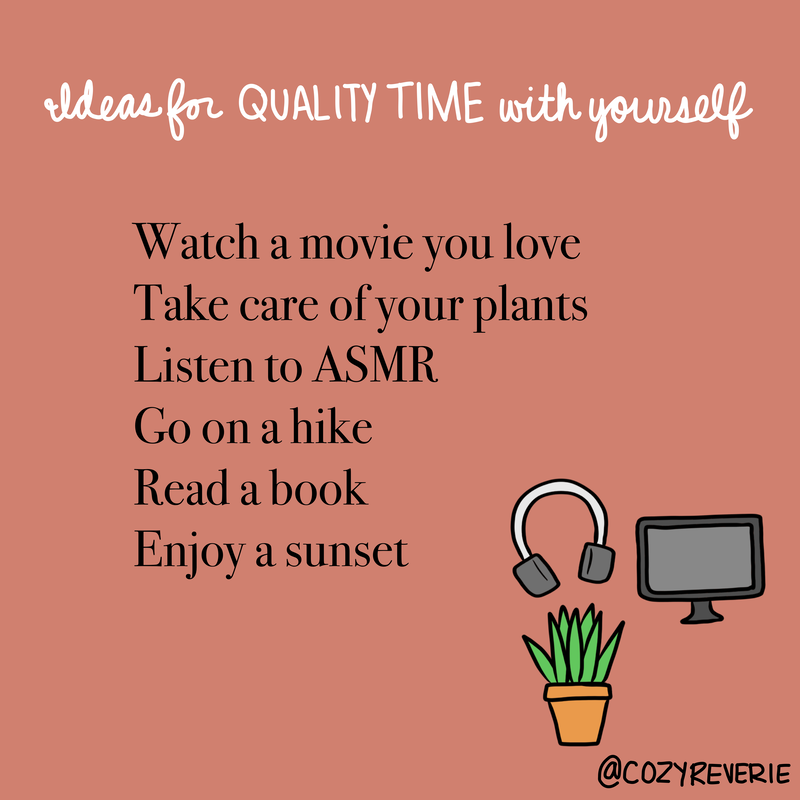


Here are some ways to show yourself some love with quality time:

  • Set aside time for daily mindfulness practices such as meditation or deep breathing exercises.
  • Make time for leisure and hobbies. Time for play and enjoyment is an important aspect of life.
  • Prioritize sleep and exercise 
  • Do not over-schedule, over-book or over-commit.
  • Take yourself on a date - dinner and a movie? Yes please. 
  • A night in - hot bubble bath and soothing music.
  • Do some Yoga stretches at home. 
  • Go for a nature hike. 
  • Visit an art museum alone. 
  • Try aromatherapy

5. Physical Touch: Feel Self-Love

Physical touch in the context of self care love languages means that you appreciate self love activities that are physically involved from a relaxing massage to the feeling of comfortable pajamas on your skin.


Here are some ideas for self love and physical touch:

  • Stretch your muscles and give yourself a massage with a foam roller. 
  • Release toxins by taking a hot bath with Epsom salts or essential oils. Release the stress and soak in the love. 
  • Moisturize your skin with lotions or oils. As you touch your skin, thank each body part for all it does for you.
  • Give yourself a spa treatment: manicure, pedicure, facial, deep conditioning treatment, etc. 
  • Dance 

  • Take yourself on a coffee date with a great book.

  • Get a message or give yourself a massage
  • Take a day to just simply rest and do nothing.

Fostering a loving relationship with yourself is incredibly healing and helps you connect with others more authentically. 


And just for giggles and laughs....


Leave me a comment with your love language. I'd love to know!

https://linktr.ee/deelitefulphotography

Don't forget to subscribe!


Tuesday, March 1, 2022

Self-Love Masterclass #15

Today is one of those days for me. Struggling with my inner critic. That voice that tells me I'm a loser. The voice that says "look at their photos. You aren't that good." The voice that says "It's time to give up and throw in the towel. You're never going to be successful."  Blah. Blah. Blah. 

I know that voice very well. 

It's that nasty Inner Critic. That voice that cries out for failure.
  

*****************************************************************************************

How do we deal with that inner critic?

The private conversations we have with ourselves can be either a powerful step or a major obstacle to reaching your goals.  If your inner voice tells you things like, “I’m going to embarrass myself,” or “No one is going to talk to me,” as you walk you into a party, you probably won't appear relaxed and approachable. Or, if you’re thinking, “I’m never going to get this job,” in the middle of an interview, you'll struggle to present yourself in a confident manner. Often, those negative predictions can quickly turn into a self-fulfilling prophecy.

Our thoughts greatly influence how we feel and behave which can cause negative self-talk to become downright self-destructive. Telling ourselves that we’ll never be successful or that we aren’t as good as other people, will reduce our feelings of self-worth and deter us from facing our fears.

If you tend to be overly critical of yourself, you're not alone. Most of us experience self-doubt and harsh self-criticisms at some point in our lives. Fortunately, we don’t have to be a victim of our own verbal abuse. Instead, we can take steps towards managing our negative thoughts and develop a more productive self-talk. Here are some ways to tame your inner critic:

  1. Develop an awareness of your thoughts. We get so used to hearing our self-talk that it’s easy to become unaware of the messages that we’re telling ourselves. Pay attention to what you’re thinking about and recognize that just because you think something, doesn’t mean it’s true. Our thoughts are often exaggerated, biased, and disproportionate.

  2. Stop overthinking (I know – easier said than done). When you make a mistake or you’ve had a bad day, you may be tempted to re-play the events over and over in your head. But, repeatedly reminding yourself of that embarrassing thing you did, or that questionable thing you said, will only make you feel worse and it won’t solve the problem. When you find yourself overthinking – and not actively problem-solving – don’t waste time telling yourself, “Don’t think about that.” The more you try to avoid thinking about something, the more you’re likely to focus on it. Instead, distract yourself with an activity – like going for a walk, organizing your desk, or talking about a completely different subject – and stop the critical thoughts before they spiral out of control.

  3. Ask yourself what advice you’d give to a friend. If a friend expressed feelings of self-doubt, hopefully you wouldn’t say, “You can’t ever do anything right,” or “You’re so stupid. No one likes you.” Yet, we’re often quick to say those things to ourselves. Instead, you’d be more likely to offer a friend compassionate words of encouragement like, “You made a mistake but it’s not the end of the world,” or “It’s unlikely that today’s performance will actually get you fired.” Treat yourself equally as kind as you’d treat a friend and apply those words of encouragement to your life.

  4. Examine the evidence. Learn to recognize when your critical thoughts are exaggeratedly negative. If you think, “I’m never going to be able to quit my job and run my own business,” examine the evidence that supports and refutes this prediction. Sometimes it’s helpful to write it down. Draw a line down the middle of a piece of paper. On one side, list all the evidence that supports your thought. On the other side, write down all the evidence to the contrary. Looking at evidence on both sides of the argument can help you look at the situation more rationally and less emotionally.

  5. Replace overly critical thoughts with more accurate statements. Convert an overly negative thought to a more rational and realistic statement. When you find yourself thinking, “I never do anything right,” replace it with a balanced statement like, “Sometimes I do things really well and sometimes I don’t.” Each time you find yourself thinking an exaggeratedly negative thought, respond with the more accurate statement.

  6. Consider how bad it would be if your thoughts were true. Sometimes it’s tempting to picture a mistake turning into a complete catastrophe. But often, the worst case scenario really isn’t as bad as we might imagine. For example, if you predict that you’re going to embarrass yourself when you give a presentation, ask yourself how bad would that actually be? If you did embarrass yourself, would you be able to recover or do think it would it end your career? Reminding yourself that you can handle tough times or problems increases your confidence and decreases the constant barrage of worrisome thoughts.

  7. Balance acceptance with self-improvement. There’s a difference between always telling yourself that you’re not good enough and reminding yourself that you can work to become better. Accept your flaws for what they are today but resign to work on the issues you want to address. Although it sounds illogical, you can do both at the same time. You can accept that you experience anxiety in social situations, while also making a decision to become more comfortable with public speaking. Accepting your weaknesses for what they are today doesn’t mean you have to stay that way. Acknowledge that you have flaws but stay determined to remain a work in progress as you strive to become better.

  8. The Power of Your Inner Dialogue Your inner dialogue will either fuel your success or prevent you from reaching your full potential. While your inner critic can help you recognize areas where you want to improve, overly harsh negative self-talk will cause your goals and decisions to suffer and reduce the chances that you’ll reach your goals. Practice taming your inner critic and silencing the negativity so you can coach yourself in a productive and helpful manner.

Our inner critics – whatever we may call them – have a powerful influence over our inner lives. They determine not just our overall psychological well-being, but also how successful we are.

The original function of our critical inner voice was to protect us from danger, but later in life negative self-talk can become a major unhealthy habit with wide-ranging negative consequences. But by noticing and labeling these critical inner voices, and practicing the skills outlined above, we can significantly lessen their effect.

If our inner critic were a person, we would avoid them like the plague. They would no doubt fall into the category of an abuser: someone who consistently tears down our sense of self-worth; someone who mocks, berates, and demeans us; who constantly says the most horrific things about us and makes us feel ashamed, guilty, small, and miserable.

Would we tolerate this kind of talk if it were directed at a child, friend, or someone we love? Why, then, should we accept it as our own normalcy? 

Leave me a comment if you relate. Or if you have managed to overcome your own inner critic. 


Empowering Yourself: Transforming Negative Self-Talk into Positive Affirmations

We all have an inner voice that whispers to us, shaping our thoughts and beliefs about ourselves. However, sometimes that voice can be far f...